
source https://www.sciencedaily.com/releases/2022/02/220211102608.htm
The source code of a program should be readable to human. Making it run correctly is only half of its purpose. Without a properly commenting code, it would be difficult for one, including the future you, to understand the rationale and intent behind the code. It would also make the code impossible to maintain. In Python, there are multiple ways to add descriptions to the code to make it more readable or make the intent more explicit. In the following, we will see how we should properly use comments, docstrings, and type hints to make our code easier to understand. After finishing this tutorial, you will know
Let’s get started.

Comments, docstrings, and type hints in Python code. Photo by Rhythm Goyal. Some rights reserved
This tutorial is in 3 parts, they are
Almost all programming languages have dedicated syntax for comments. Comments are to be ignored by compilers or interpreters and hence they have no effect to the programming flow or logic. But with comments, we are easier to read the code.
In languages like C++, we can add “inline comments” with a leading double slash (//) or add comment blocks enclosed by /* and */. However, in Python we only have the “inline” version and they are introduced by the leading hash character (#).
It is quite easy to write comments to explain every line of code but usually that is a waste. When people read the source code, quite often comments are easier to catch attention and hence putting too much comments would distract the reading. For example, the following is unnecessary and distracting:
import datetime


timestamp = datetime.datetime.now()  # Get the current date and time

x = 0    # initialize x to zero
Comments like these is merely repeating what the code does. Unless the code is obscured, these comments added no value to the code. The example below might be a marginal case, in which the name “ppf” (percentage point function) is less well-known than the term “CDF” (cumulative distribution function):
import scipy.stats


z_alpha = scipy.stats.norm.ppf(0.975)  # Call the inverse CDF of standard normal
Good comments should be telling why we are doing something. Let’s look at the following example:
def adadelta(objective, derivative, bounds, n_iter, rho, ep=1e-3):

    # generate an initial point

    solution = bounds[:, 0] + rand(len(bounds)) * (bounds[:, 1] - bounds[:, 0])

    # lists to hold the average square gradients for each variable and

    # average parameter updates

    sq_grad_avg = [0.0 for _ in range(bounds.shape[0])]

    sq_para_avg = [0.0 for _ in range(bounds.shape[0])]

    # run the gradient descent

    for it in range(n_iter):

        gradient = derivative(solution[0], solution[1])

        # update the moving average of the squared partial derivatives

        for i in range(gradient.shape[0]):

            sg = gradient[i]**2.0

            sq_grad_avg[i] = (sq_grad_avg[i] * rho) + (sg * (1.0-rho))

        # build a solution one variable at a time

        new_solution = list()

        for i in range(solution.shape[0]):

            # calculate the step size for this variable

            alpha = (ep + sqrt(sq_para_avg[i])) / (ep + sqrt(sq_grad_avg[i]))

            # calculate the change and update the moving average of the squared change

            change = alpha * gradient[i]

            sq_para_avg[i] = (sq_para_avg[i] * rho) + (change**2.0 * (1.0-rho))

            # calculate the new position in this variable and store as new solution

            value = solution[i] - change

            new_solution.append(value)

        # evaluate candidate point

        solution = asarray(new_solution)

        solution_eval = objective(solution[0], solution[1])

        # report progress

        print('>%d f(%s) = %.5f' % (it, solution, solution_eval))

    return [solution, solution_eval]
The function above is implementing AdaDelta algorithm. At the first line, when we assign something to the variable solution, we do not write comments like “a random interpolation between bounds[:,0] and bounds[:,1]” because that is just repeating the code literally. We say the intent of this line is to “generate an initial point”. Similarly for the other comments in the function, we mark one of the for loop as the gradient descent algorithm rather than just saying iterate for certain times.
One important issue we want to remember when writing the comment or modifying code is to make sure the comment accurately describe the code. If they are contradicting, it would be confusing to the readers. If we should not put the comment on the first line of the above example to “set initial solution to the lowerbound” while the code obviously is randomizing the initial solution, or vice versa. If this is what you intented to do, you should update the comment and the code at the same time.
An exception would be the “to-do” comments. From time to time, when we have an idea on how to improve the code but not yet changed it, we may put a to-do comments on the code. We can also use it to mark incomplete implementations. For example,
# TODO replace Keras code below with Tensorflow

from keras.models import Sequential

from keras.layers import Conv2D


model = Sequential()

model.add(Conv2D(1, (3,3), strides=(2, 2), input_shape=(8, 8, 1)))

model.summary()

...
This is a common practice and many IDE will highlight the comment block differently when the keyword TODO is found. However, it suppposed to be temporary and we should not abuse it as an issue tracking system.
In summary, some common “best practice” on commenting code as listed as follows:
In C++, we may write a large block of comments such as in the following:
TcpSocketBase::~TcpSocketBase (void)

{

  NS_LOG_FUNCTION (this);

  m_node = nullptr;

  if (m_endPoint != nullptr)

    {

      NS_ASSERT (m_tcp != nullptr);

      /*

       * Upon Bind, an Ipv4Endpoint is allocated and set to m_endPoint, and

       * DestroyCallback is set to TcpSocketBase::Destroy. If we called

       * m_tcp->DeAllocate, it will destroy its Ipv4EndpointDemux::DeAllocate,

       * which in turn destroys my m_endPoint, and in turn invokes

       * TcpSocketBase::Destroy to nullify m_node, m_endPoint, and m_tcp.

       */

      NS_ASSERT (m_endPoint != nullptr);

      m_tcp->DeAllocate (m_endPoint);

      NS_ASSERT (m_endPoint == nullptr);

    }

  if (m_endPoint6 != nullptr)

    {

      NS_ASSERT (m_tcp != nullptr);

      NS_ASSERT (m_endPoint6 != nullptr);

      m_tcp->DeAllocate (m_endPoint6);

      NS_ASSERT (m_endPoint6 == nullptr);

    }

  m_tcp = 0;

  CancelAllTimers ();

}
But in Python, we do not have the equivalent to the delimiters /* and */, but we can write multi-line comments like the following instead:
async def main(indir):

    # Scan dirs for files and populate a list

    filepaths = []

    for path, dirs, files in os.walk(indir):

        for basename in files:

            filepath = os.path.join(path, basename)

            filepaths.append(filepath)


    """Create the "process pool" of 4 and run asyncio.

    The processes will execute the worker function

    concurrently with each file path as parameter

    """

    loop = asyncio.get_running_loop()

    with concurrent.futures.ProcessPoolExecutor(max_workers=4) as executor:

        futures = [loop.run_in_executor(executor, func, f) for f in filepaths]

        for fut in asyncio.as_completed(futures):

            try:

                filepath = await fut

                print(filepath)

            except Exception as exc:

                print("failed one job")
This works because Python supports to declare a string literal spanning across multiple lines if it is delimited with triple quotation marks ("""). And a string literal in the code is merely a string declared with no impact. Therefore it is functionally no different to the comments.
One reason we want to use string literals is to comment out a large block of code. For example,
from sklearn.linear_model import LogisticRegression

from sklearn.datasets import make_classification

"""

X, y = make_classification(n_samples=5000, n_features=2, n_informative=2,

                           n_redundant=0, n_repeated=0, n_classes=2,

                           n_clusters_per_class=1,

                           weights=[0.01, 0.05, 0.94],

                           class_sep=0.8, random_state=0)

"""

import pickle

with open("dataset.pickle", "wb") as fp:

    X, y = pickle.load(fp)


clf = LogisticRegression(random_state=0).fit(X, y)

...
The above is a sample code that we may develop with experimenting on a machine learning problem. While we generated a dataset randomly at the beginning (the call to make_classification() above), we may want to switch to a different dataset and repeat the same process at a later time (e.g., the pickle part above). Rather than removing the block of code, we may simply comment those lines so we can store the code later. It is not in a good shape for the finalized code but convenient while we are developing our solution.
The string literal in Python as comment has a special purpose if it is at the first line under a function. The string literal in that case is called the “docstring” of the function. For example,
def square(x):

    """Just to compute the square of a value


    Args:

        x (int or float): A numerical value


    Returns:

        int or float: The square of x

    """

    return x * x
We can see the first line under the function is a literal string and it serve as the same purpose as comment. It makes the code more readable, but at the same time, we can retrieve it from the code:
print("Function name:", square.__name__)

print("Docstring:", square.__doc__)
Function name: square

Docstring: Just to compute the square of a value


    Args:

        x (int or float): A numerical value


    Returns:

        int or float: The square of x
Because of the special status of the docstring, there are several conventions on how to write a proper one.
In C++ we may use Doxygen to generate code documentation from comments and similarly we have Javadoc for Java code. The closest match in Python would be the tool “autodoc” from Sphinx or pdoc. Both will try to parse the docstring to generate documentations automatically.
There are no standard way of making docstrings but generally we expect they will explain the purpose of a function (or a class or module) as well as the arguments and the return values. One common style is like the one above, which is advocated by Google. A different style is from NumPy:
def square(x):

    """Just to compupte the square of a value


    Parameters

    ----------

    x : int or float

        A numerical value


    Returns

    -------

    int or float

        The square of `x`

    """

    return x * x
Tools such as autodoc can parse these docstring and generate the API documentation. But even if it is not the purpose, having a docstring describing the nature of the function, the data types of the function arguments and return values can surely make your code easier to read. This is particularly true since Python, unlike C++ or Java, is a duck-typing language which variables and function arguments are not declared with a particular type. We can make use of docstring to spell out the assumption of the data type so people are easier to follow or use your function.
Since Python 3.5, type hint syntax is allowed. As the name implies, its purpose is to hint for the type, and nothing else. Hence even it looks like to bring Python closer to Java, it does not mean to restrict the data to be stored in a variable. The example above can be rewritten with type hint:
def square(x: int) -> int:

    return x * x
In a function, the arguments can be followed by a : type syntax to spell out the intended types. The return value of a function is identified by the -> type syntax before the colon. In fact, type hint can be declared for variables too, e.g.,
def square(x: int) -> int:

    value: int = x * x

    return value
The benefit of type hint is two fold: We can use it to eliminate some comments if we need to describe explicitly the data type being used. We can also help static analyzers to understand our code better so they can help identifying potential issues in the code.
Sometimes the type can be complex and therefore Python provided the typing module in its standard library to help clean up the syntax. For example, we can use Union[int,float] to mean int type or float type, List[str] to mean a list that every element is a string, and use Any to mean anything. Like as follows:
from typing import Any, Union, List


def square(x: Union[int, float]) -> Union[int, float]:

    return x * x


def append(x: List[Any], y: Any) -> None:

    x.append(y)
However, it is important to remember that type hints are hints only. It does not impose any restriction to the code. Hence the following is confusing to the reader, but perfectly fine:
n: int = 3.5

n = "assign a string"
Using type hints may improve the readability of the code. However, the most important benefit of type hint is to allow static analyzer such as mypy to tell us whether our code has any potential bug. If you process the above lines of code with mypy, we will see the following error:
test.py:1: error: Incompatible types in assignment (expression has type "float", variable has type "int")

test.py:2: error: Incompatible types in assignment (expression has type "str", variable has type "int")

Found 2 errors in 1 file (checked 1 source file)
The use of static analyzers will be covered in another post.
To illustrate the use of comments, docstrings, and type hints, below is an example to define a generator function that samples a pandas DataFrame on fixed-width windows. It is useful for training a LSTM network, which a few consecutive time steps should be provided. In the function below, we start from a random row on the DataFrame and clip a few rows following it. As long as we can successfully get one full window, we take it as a sample. Once we collected enough samples to make a batch, the batch is dispatched.
You should see that it is clearer if we can provide type hints on the function arguments so we know, for example, data is supposed to be a pandas DataFrame. But we describe further that it is expected to carry a datetime index in the docstring. The describe the algorithm on how to exact a window of rows from the input data as well as the intention of the “if” block in the inner while-loop using comments. In this way, the code would be much easier to understand and much easier to maintain, or modified for other use.
from typing import List, Tuple, Generator

import pandas as pd

import numpy as np


TrainingSampleGenerator = Generator[Tuple[np.ndarray,np.ndarray], None, None]


def lstm_gen(data: pd.DataFrame,

             timesteps: int,

             batch_size: int) -> TrainingSampleGenerator:

    """Generator to produce random samples for LSTM training


    Args:

        data: DataFrame of data with datetime index in chronological order,

              samples are drawn from this

        timesteps: Number of time steps for each sample, data will be

                   produced from a window of such length

        batch_size: Number of samples in each batch


    Yields:

        ndarray, ndarray: The (X,Y) training samples drawn on a random window

        from the input data

    """

    input_columns = [c for c in data.columns if c != "target"]

    batch: List[Tuple[pd.DataFrame, pd.Series]] = []

    while True:

        # pick one start time and security

        while True:

            # Start from a random point from the data and clip a window

            row = data["target"].sample()

            starttime = row.index[0]

            window: pd.DataFrame = data[starttime:].iloc[:timesteps]

            # If we are at the end of the DataFrame, we can't get a full

            # window and we must start over

            if len(window) == timesteps:

                break

        # Extract the input and output

        y = window["target"]

        X = window[input_columns]

        batch.append((X, y))

        # If accumulated enough for one batch, dispatch

        if len(batch) == batch_size:

            X, y = zip(*batch)

            yield np.array(X).astype("float32"), np.array(y).astype("float32")

            batch = []
This section provides more resources on the topic if you are looking to go deeper.
In this tutorial, you’ve see how we should use the comments, docstrings, and type hints in Python. Specifically, you now knows
The post Comments, docstrings, and type hints in Python code appeared first on Machine Learning Mastery.
Last Updated on January 27, 2022
Derivatives are one of the most fundamental concepts in calculus. They describe how changes in the variable inputs affect the function outputs. The objective of this article is to provide a high-level introduction to calculating derivatives in PyTorch for those who are new to the framework. PyTorch offers a convenient way to calculate derivatives for user-defined functions.
While we always have to deal with backpropagation (an algorithm known to be the backbone of a neural network) in neural networks, which optimizes the parameters to minimize the error in order to achieve higher classification accuracy; concept learned in this article will be used in later posts on deep learning for image processing and other computer vision problems.
After going through this tutorial, you’ll learn:
Let’s get started.

Calculating Derivatives in PyTorch
Picture by Jossuha Théophile. Some rights reserved.
The autograd – an auto differentiation module in PyTorch – is used to calculate the derivatives and optimize the parameters in neural networks. It is intended primarily for gradient computations.
Before we start, let’s load up some necessary libraries we’ll use in this tutorial.
import matplotlib.pyplot as plt

import torch
Now, let’s use a simple tensor and set the requires_grad parameter to true. This allows us to perform automatic differentiation and lets PyTorch evaluate the derivatives using the given value which, in this case, is 3.0.
x = torch.tensor(3.0, requires_grad = True)

print("creating a tensor x: ", x)
creating a tensor x: tensor(3., requires_grad=True)
We’ll use a simple equation $y=3x^2$ as an example and take the derivative with respect to variable x. So, let’s create another tensor according to the given equation. Also, we’ll apply a neat method .backward on the variable y that forms acyclic graph storing the computation history, and evaluate the result with .grad for the given value.
y = 3 * x ** 2

print("Result of the equation is: ", y)

y.backward()

print("Dervative of the equation at x = 3 is: ", x.grad)
Result of the equation is:  tensor(27., grad_fn=<MulBackward0>)

Dervative of the equation at x = 3 is:  tensor(18.)
As you can see, we have obtained a value of 36, which is correct.
PyTorch generates derivatives by building a backwards graph behind the scenes, while tensors and backwards functions are the graph’s nodes. In a graph, PyTorch computes the derivative of a tensor depending on whether it is a leaf or not.
PyTorch will not evaluate a tensor’s derivative if its leaf attribute is set to True. We won’t go into much detail about how the backwards graph is created and utilized, because the goal here is to give you a high-level knowledge of how PyTorch makes use of the graph to calculate derivatives.
So, let’s check how the tensors x and y look internally once they are created. For x:
print('data attribute of the tensor:',x.data)

print('grad attribute of the tensor::',x.grad)

print('grad_fn attribute of the tensor::',x.grad_fn)

print("is_leaf attribute of the tensor::",x.is_leaf)

print("requires_grad attribute of the tensor::",x.requires_grad)
data attribute of the tensor: tensor(3.)

grad attribute of the tensor:: tensor(18.)

grad_fn attribute of the tensor:: None

is_leaf attribute of the tensor:: True

requires_grad attribute of the tensor:: True
and for y:
print('data attribute of the tensor:',y.data)

print('grad attribute of the tensor:',y.grad)

print('grad_fn attribute of the tensor:',y.grad_fn)

print("is_leaf attribute of the tensor:",y.is_leaf)

print("requires_grad attribute of the tensor:",y.requires_grad)
print('data attribute of the tensor:',y.data)

print('grad attribute of the tensor:',y.grad)

print('grad_fn attribute of the tensor:',y.grad_fn)

print("is_leaf attribute of the tensor:",y.is_leaf)

print("requires_grad attribute of the tensor:",y.requires_grad)
As you can see, each tensor has been assigned with a particular set of attributes.
The data attribute stores the tensor’s data while the grad_fn attribute tells about the node in the graph. Likewise, the .grad attribute holds the result of the derivative. Now that you have learnt some basics about the autograd and computational graph in PyTorch, let’s take a little more complicated equation $y=6x^2+2x+4$ and calculate the derivative. The derivative of the equation is given by:
$$\frac{dy}{dx} = 12x+2$$
Evaluating the derivative at $x = 3$,
$$\left.\frac{dy}{dx}\right\vert_{x=3} = 12\times 3+2 = 38$$
Now, let’s see how PyTorch does that,
x = torch.tensor(3.0, requires_grad = True)

y = 6 * x ** 2 + 2 * x + 4

print("Result of the equation is: ", y)

y.backward()

print("Derivative of the equation at x = 3 is: ", x.grad)
Result of the equation is:  tensor(64., grad_fn=<AddBackward0>)

Derivative of the equation at x = 3 is:  tensor(38.)
The derivative of the equation is 38, which is correct.
PyTorch also allows us to calculate partial derivatives of functions. For example, if we have to apply partial derivation to the following function,
$$f(u,v) = u^3+v^2+4uv$$
Its derivative with respect to $u$ is,
$$\frac{\partial f}{\partial u} = 3u^2 + 4v$$
Similarly, the derivative with respect to $v$ will be,
$$\frac{\partial f}{\partial v} = 2v + 4u$$
Now, let’s do it the PyTorch way, where $u = 3$ and $v = 4$.
We’ll create u, v and f tensors and apply the .backward attribute on f in order to compute the derivative. Finally, we’ll evaluate the derivative using the .grad with respect to the values of u and v.
u = torch.tensor(3., requires_grad=True)

v = torch.tensor(4., requires_grad=True)


f = u**3 + v**2 + 4*u*v


print(u)

print(v)

print(f)


f.backward()

print("Partial derivative with respect to u: ", u.grad)

print("Partial derivative with respect to u: ", v.grad)
tensor(3., requires_grad=True)

tensor(4., requires_grad=True)

tensor(91., grad_fn=<AddBackward0>)

Partial derivative with respect to u:  tensor(43.)

Partial derivative with respect to u:  tensor(20.)
What if we have a function with multiple values and we need to calculate the derivative with respect to its multiple values? For this, we’ll make use of the sum attribute to (1) produce a scalar valued function, and then (2) take the derivative. This is how we can see the ‘function vs. derivative’ plot:
# compute the derivative of the function with multiple values

x = torch.linspace(-20, 20, 20, requires_grad = True)

Y = x ** 2

y = torch.sum(Y)

y.backward()


# ploting the function and derivative

function_line, = plt.plot(x.detach().numpy(), Y.detach().numpy(), label = 'Function')

function_line.set_color("red")

derivative_line, = plt.plot(x.detach().numpy(), x.grad.detach().numpy(), label = 'Derivative')

derivative_line.set_color("green")

plt.xlabel('x')

plt.legend()

plt.show()
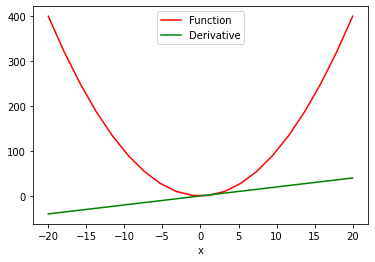
In the two plot() function above, we extract the values from PyTorch tensors so we can visualize them. The .detach method doesn’t allow the graph to further track the operations. This makes it easy for us to convert a tensor to a numpy array.
In this tutorial, you learned how to implement derivatives on various functions in PyTorch.
Particularly, you learned:
The post Calculating Derivatives in PyTorch appeared first on Machine Learning Mastery.
Researchers have developed a system based on computer vision techniques that allows automatic analysis of biomedical videos captured by mic...


